What is Blue Ocean in Jenkins? Blue Ocean is made on the grounds of the consumer's Jenkins experience. It's mostly made for the pipeline procedure, but it could also perform freestyle tasks. Blue Ocean lessens the disease and chaos brought on by the Jenkins and also raises the clarity for every team member. Blue Ocean is quite helpful for a completely proficient user that understands Jenkins features very nicely. Nonetheless, if you're just beginning, you might have to understand Jenkins's fundamentals , particularly concerning Jenkin's pipeline procedure. The title Blue Ocean is chosen in the publication >> " Blue Ocean Strategy ." Main characteristics of Blue Ocean Supports freestyle tasks: though it's made for the pipeline procedure, additionally, it supports freestyle tasks. Even it's possible to run a single task on it. Every member of the group can easily picture the implementation and modification made from the builds...
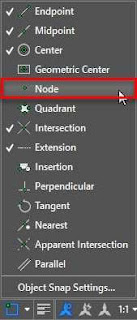
Point Command in AutoCAD Points in AutoCAD 2D may provide excellent reference points for additional drawings. In this post, we'll demonstrate how to construct single and multiple points in AutoCAD 2D, along with the command that accomplishes this. Using the POINT or PO command in AutoCAD , you may create simple points, also known as nodes. Simply write PO, hit Enter, and then click at a position in the drawing area to produce a point, or enter the coordinates of the desired point. The point will by default show up as a single dot in the drawing area, and you may use these points as references to create your design. To modify this, activate the node option in the object snap status bar option as shown in the image below. By default, the points won't be selectable. A different point types The default point is a tiny pixel-sized dot, which works well for the majority of purposes, including creating references. However, the PTYPE command also allows you to alter t...
When it comes to web development, PHP frameworks are the best. There are many PHP frameworks on the market. However, Symfony and Laravel are the most popular. It can be difficult to choose which one is best for your project. Both Symfony and Laravel have their pros and cons. We have done our best to make a quick comparison between these two frameworks. We hope you find this study helpful and that it will help you decide which one is the best for you. Laravel & Symfony – basic information about both frameworks Laravel is an open-source framework that accompanies a model-view-controller design guide. It uses components from different frameworks to create a web app. It includes the fundamental characteristics of PHP frameworks like CodeIgniter, Yii, and Ruby on Rails. Core knowledge is a must. PHP You will find Advanced PHP Laravel easier to use. It's well-known for its simplicity in coding and the reduction of d...
Comments
Post a Comment